Exploring John Draim’s Common-Period
Four-Satellite Constellation
Spurred by an investigation into communications network (CommNet) satellite constellations for Kerbal Space Program, this evolved into an exercise in generalizing the constellation for arbitrary systems.
Key objectives include minimizing computation time, analyzing more complex systems, and determining tolerance ranges when above the minimum orbital period.
Background
Kerbal Space Program is, put simply, an engineer’s sandbox; it explores aerospace engineering in as much detail as possible without reaching into the realm of specialized study and, despite its successor’s lackluster performance, still maintains a small but dedicated community.
One major feature of the game is that probes require a communications link to function, necessitating the deployment of communications satellites. There are many ways to do this, each with varying efficacy and efficiency, but the most efficient method uses only 4 satellites. This configuration, published by John Draim in 1987, provides uninterrupted coverage for, in theory, any celestial body, and the KSP community has applied this method to Kerbin, shown below.
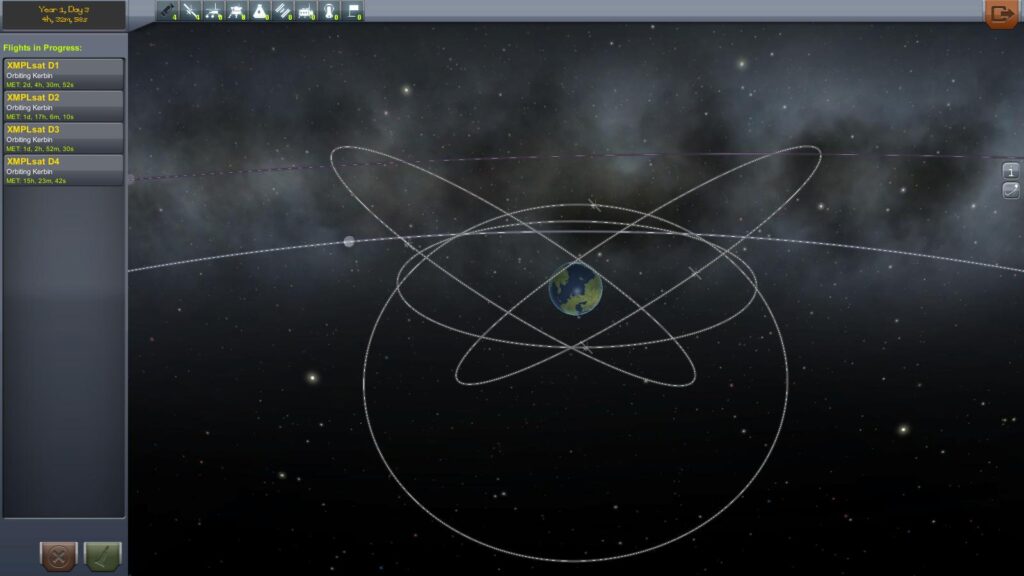
While this arrangement is effective, the underlying theory is constructed around two-body systems of a planet or moon and satellites. Thus, in my analysis, I aim to expand this method to be used with more complex systems and at lower computational overhead.
Sections
- Placeholder
Something something true anomaly
Something something true anomaly